
Waiter Call Lights for Restaurants and Bars: How Flip Lamps Work
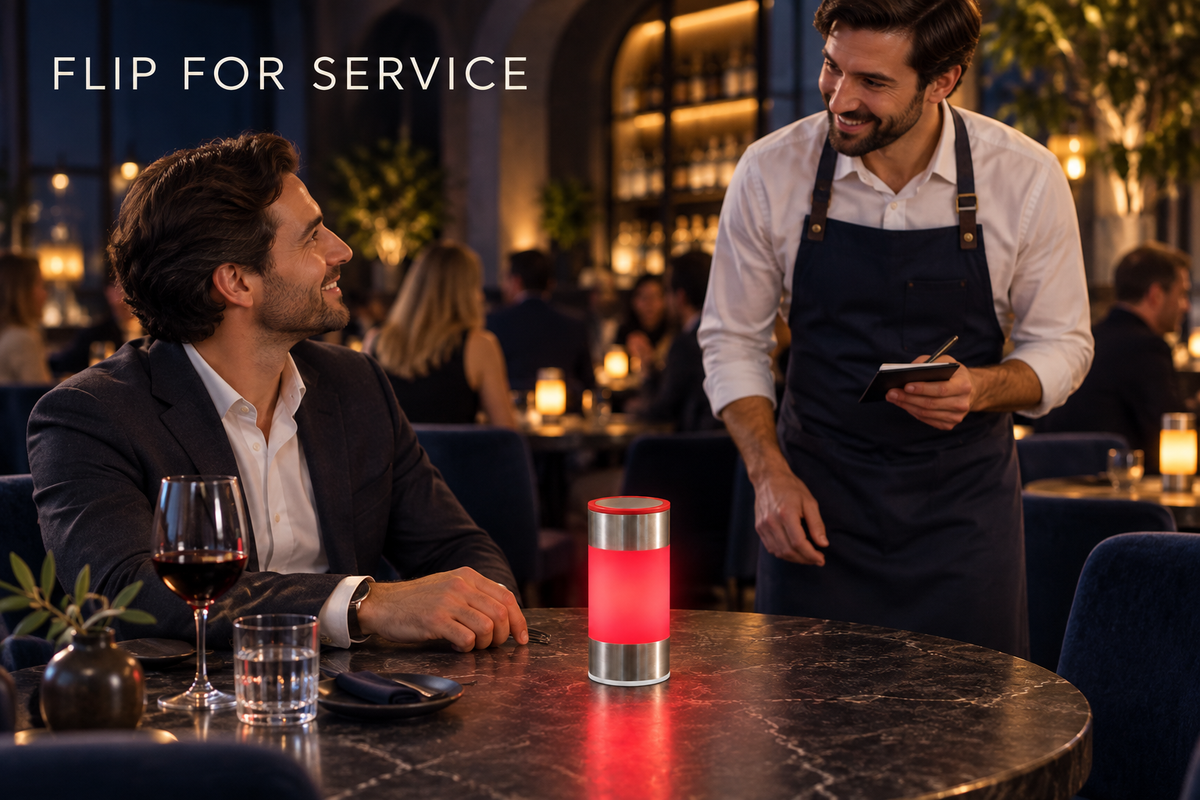
A waiter call light is a visible table signal that tells staff a guest needs attention. In a noisy bar, a guest’s voice can disappear into music and conversation. A flip waiter call lamp gives the table a visible way to ask for attention: turn the red-ring end upward, and the lamp changes from ambient lighting to a red service signal.
Jianbian Lighting Technology (zhongshan) Co., Ltd. manufactures cordless RGB flip waiter call table lamps for restaurants, bars and hospitality projects. Alongside the flip-to-red function, we offer centralized charging and station-based settings, with OEM, ODM, logo and packaging support for project requirements.
A guest can request attention without raising their voice or repeatedly trying to catch a passing waiter. The red light is a visual cue for staff who can see the table; a clear staff response routine remains essential.


1. Why visual signals help in noisy bars
Music, conversations and a busy service area can make a spoken request difficult to hear. A raised hand can also be missed while staff carry drinks or attend another table. For the guest, the frustrating part is often not knowing whether their request has been noticed.
A dedicated red table light makes the request visible without adding another sound to the room. It identifies the table asking for attention and lets guests remain seated while staff work through their section. The signal is especially relevant to bar seating, restaurant booths and lounge tables that stay within the team’s sightlines.
Placement matters. Tall menus, bottles, partitions and guests themselves can hide a small lamp. Position it where staff can see it from their normal route, and reserve red for service requests so it stands apart from the venue’s ambient colors.
2. How the flip-to-call function works
- Start with ambience. Place the lamp with its white-ring end upward. The selected ambient color becomes part of the table setting.
- Flip to ask for service. The guest turns the lamp so the red-ring end faces upward. The gravity-activated change produces the red service signal.
- Acknowledge the table. Staff notice the red light, acknowledge the guest and attend to the request.
- Return to ambience. Once the request has been handled, turn the white-ring end upward again. Include this reset in the staff routine.

Introduce the action when seating guests. A short explanation is enough: “If you need us, turn the red end upward.” This is a visual table signal. Its service-request workflow does not depend on the guest’s voice being heard over the music.
PRODUCT HIGHLIGHTS
- Flip-activated red signal — A simple change of orientation gives seated guests a visible way to ask for service in a noisy bar.
- Separate ambience and service states — White-ring-up ambient lighting and red-ring-up signaling help restaurant teams distinguish the table’s two uses.
- Centralized charging — A recommended 15-lamp batch supports an organized return-and-charge routine for hospitality teams.
- Station-based settings — Mode, brightness and color controls let staff prepare lamps together before placing them around the venue.
- Compact cordless format — The Ø55 × H137 mm lamp can be positioned on a dining table without a power cable running across it.
- Project customization — OEM, ODM, logo and packaging support help buyers coordinate lamps with a restaurant or hotel project.
3. Set the mode, brightness and color before service
Place the lamps on the station to apply settings before distributing them to tables. The control panel groups the functions under Mode, OFF, Intensity and COLOR.

- Mode: choose solid red or gradual red for the service signal.
- Intensity: select one of four brightness levels.
- COLOR: choose from white, yellow, green, cyan, purple, pink and orange for ambience.
- OFF: switch lamps off for transport.
Keep the service signal consistent across a staff section. Use the other colors to support the venue’s theme, and choose brightness by checking the lamp at an occupied table under the lighting used during service. An attractive setting at an empty table may look different once glassware, menus and guests are in place.
4. Plan centralized charging around the shift
The recommended charging arrangement is 15 lamps per station per batch. Collect lamps after service, bring them to the charging area and prepare the next set together. Keep charging and color setup in the same preparation routine so staff know which lamps are ready to return to tables.

For a larger installation, plan station quantities and batch rotation around the number of lamps in use. As a planning example, 30 lamps can be divided into two 15-lamp batches; the venue then needs a charging arrangement that fits its operating schedule.
Do not equate packing quantity with charging capacity. A project package containing more than 15 lamps does not change the recommended simultaneous charging batch. Assess useful runtime at your chosen brightness and mode during a sample trial before setting the venue’s rotation schedule.
Explore centralized charging solutions →
5. A closer look at the product source
Jianbian Lighting is based in Guzhen, Zhongshan, China, and supplies lighting for restaurant, bar and hotel projects. The two photographs below show actual lamps and a charging station in our workshop, including illuminated samples and a batch of lamp bodies on the workbench.


These photographs give buyers a view of the physical products behind the presentation images. For a project discussion, ask us to show the current lamp, station controls and packing configuration together. A sample review can connect the appearance shown online with the exact configuration being ordered.
We support OEM and ODM discussions as well as logo, packaging, surface treatment and product development. Send the intended venue type, lamp quantity, destination market and artwork requirements so the conversation starts with your project.
6. Check lamp, station and outer-carton dimensions
Plan both table placement and the back-of-house charging space. The lamp dimensions, station dimensions and outer-carton dimensions describe three different items.

Flip Service Lamp and Charging Set
| Parameter | Value | Parameter | Value |
|---|---|---|---|
| Lamp size | Ø55 × H137 mm | Battery | 2600mAh |
| Materials | Stainless steel + acrylic | Lighting | RGBW |
| Charging station | 535 × 430 × 180 mm | Recommended charging batch | 15 lamps |
| Outer carton | 55 × 44 × 21 cm | Package configuration | 15–25 lamps + 1 charging station |

55 × 44 × 21 cm
Project set: 15–25 lamps + 1 charging station.
Recommended charging batch: 15 lamps.
The packing photo shows separate compartments around the packed components. Select the set quantity in the project order, and retain the agreed packing specification for receiving and storage planning.
7. Run a practical trial in your bar
Test the lamp during the conditions in which it will be used. A sample placed in a quiet office cannot show whether the red signal will stand out along a crowded service route.
- Check the guest action. Can a seated guest understand the flip after a short explanation?
- Check the sightline. Can staff see the red lamp from their usual route with the table fully set?
- Check the contrast. Does the red request stand apart from the venue’s decorative lighting?
- Check the response routine. Decide who acknowledges a red signal and who returns the lamp to ambience.
- Check the charging workflow. Trial collection, 15-lamp batches and preparation before the next service period.
The lamp gives the team a visible request to act on. Service response still depends on staffing, sightlines and the venue’s routine. Use your own trial observations to decide whether it fits your tables and operating style.
Buyer questions
How do guests call a waiter with the flip lamp?
Guests turn the lamp so its red-ring end faces upward. The red light becomes the visible service request; the white-ring-up position is used for ambient lighting.
Can it help in a noisy bar?
Yes, it gives guests a visual way to request attention without relying on a spoken call being heard. Staff need a clear view of the lamp and an agreed routine for responding.
Does it send an alert to a waiter’s wrist receiver?
The function described here is a visible red signal at the table. Staff identify the requesting table by seeing the light; this guide does not describe a wrist-receiver notification system.
How many lamps should be charged in one batch?
We recommend 15 lamps per station per charging batch. A package with a different lamp quantity should still be planned around that recommended batch size.
How are brightness and colors selected?
Place the lamps on the station and use its controls. The panel provides four brightness levels, seven ambient colors, red call-mode selection and OFF for transport.
Can Jianbian Lighting support branded project orders?
Yes, we support OEM, ODM, logo and packaging discussions for project requirements. Share your venue, quantity and destination with Lewis to discuss the configuration.
Plan a visible service signal for your tables.
Tell Lewis your venue type, table count, preferred ambient color and delivery market.
View the flip waiter call lamp →
Related guide: How to Choose Cordless Table Lamps for Restaurants
Bring your table.
We'll help with the light.
Share your preferred models, estimated quantity and destination market with Lewis.